
HERBARIUM
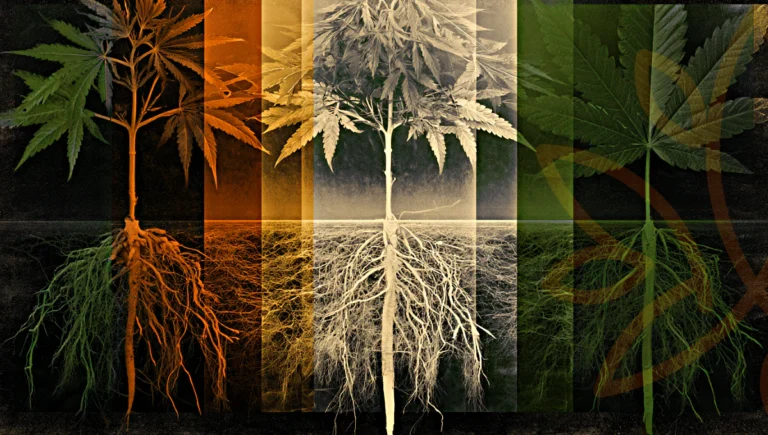
Some growers
avoid hydroponic cannabis
as if the reservoir
had committed a crime.
Others treat soil as nostalgia with worms.
Both are usually too certain.
The truth is less theatrical.
Cannabis can be grown successfully in field soil, amended beds, peat or coir substrates, mineral wool, water culture and many systems between them.
None of those categories guarantees superior yield, aroma, cannabinoid composition, microbial or chemical safety, or consistency.
Each system creates a different set of variables to manage.
The medium matters.
But the medium is not the morality.
Soil, hydroponics, mineral feeding and organic cultivation do not sit neatly on one line. They answer different questions.
The labels overlap.
The argument often begins
because the categories were wrong from the start.
The plant does not recognise a cultivation tribe.
It responds to the conditions
produced by the complete system.
Aroma, chemical composition, physical quality and yield emerge from interactions among genetics, plant development and production conditions.
Light, temperature, irrigation, mineral nutrition, root-zone conditions, harvest timing and post-harvest handling can all influence the final material.
The medium participates in that chain.
It is not the whole chain.
And one successful harvest does not prove
that the medium caused every desirable characteristic.
The argument often resembles vinyl versus digital.
Cannabis has the same problem.
A person may compare carefully selected, small-batch soil-grown flower with rushed hydroponic production and conclude that the medium explains the difference.
But the comparison changed more than the root zone.
Cultivar, scale, canopy management, harvest maturity, drying, storage and selection standards may all have changed as well.
The person may not be comparing soil with hydroponics.
They may be comparing care with haste,
or one complete system with another.
That distinction matters.
Hydroponic and soilless systems can provide direct control over irrigation and mineral delivery. They may also respond quickly when concentration, pH, oxygenation, temperature or sanitation moves outside the intended range.
Soil and amended organic substrates may buffer some short-term chemical changes and support nutrient cycling. They may also make nutrient release, moisture distribution and root-zone diagnosis less immediate.
But these are tendencies—not moral laws.
The medium does not remove complexity.
It decides where the complexity lives.
Organic cultivation and mineral nutrition should not be treated
as religion and sin.
Plant roots acquire most essential mineral nutrients as dissolved inorganic ions, with some exceptions involving other small soluble forms.
The root does not retain a moral memory of whether those nutrients entered the solution through soluble fertiliser, mineral weathering or biological decomposition.
The important differences concern timing, concentration, nutrient balance, microbial processing, losses and the grower’s ability to predict availability.
That does not make one form morally clean and the other biologically dead.
It means their release patterns and management demands differ.
In practice, many successful systems combine both approaches.
Both require humility.
Both punish certainty.
Mineral nutrition is sometimes marketed as precision.
But a precise overdose is still an overdose.
More phosphorus, higher EC or a longer feeding chart does not automatically create more flower or more cannabinoids.
Precision means supplying what the crop can use, measuring what remains and adjusting the programme before unnecessary nutrients become waste.
Biological systems are not excused from the same discipline.
Compost, amendments and microbial products are still inputs. Their nutrient content, maturity, contamination risk and rate still matter.
“Natural” does not make an input self-correcting.
“Measured”
does not make an input necessary.
The moral argument often returns through environmental language.
None of these conclusions can be made from the category alone.
The environmental ledger includes:
Sustainability is not the story printed on the bag.
It is the full resource ledger
of the production system.
A serious cannabis education should not ask the reader to join a tribe.
It should teach them to define the system before judging it.
The flower should speak.
But first, the grower must stop shouting over it.
Do not ask whether soil is morally superior to hydroponics.
Ask whether the chosen system:
Choose a medium because you understand
the work it asks from you.
Not because the label gives you
a better identity.
The medium matters.
But the medium
is not the morality.
Factual Note
Hydroponics refers broadly to growing plants without soil by supplying nutrients through a water-based solution. It can include liquid-root systems as well as aggregate substrates such as coir, perlite or vermiculite. Coir cultivation with fertigation is therefore commonly considered soilless or hydroponic even though the roots occupy a solid medium.
The root-zone medium and the nutrient source are separate variables. Soil can receive mineral fertilisers, and soilless substrates can receive organic, mineral or mixed nutrient programmes. Terms such as soil-grown, hydroponic, organic and living soil should not be treated as interchangeable descriptions of one cultivation spectrum.
Plants acquire most essential mineral nutrients as dissolved inorganic ions, although exceptions exist, including the uptake of boron primarily as boric acid. Organic nutrient sources require varying degrees of decomposition or mineralisation before some of their nutrients become available, while soluble mineral fertilisers generally provide a larger immediately available ionic fraction. The timing and efficiency of availability depend on formulation, substrate, microorganisms, temperature, moisture and crop demand.
A controlled CBD-cannabis experiment found lower late-stage nutrient acquisition and yield with the tested organic liquid fertiliser than with the tested mineral fertiliser. The authors attributed part of the difference to nutrient form and timing of availability. This result applies to the tested cultivar, formulations and conditions and does not establish a universal hierarchy between organic and mineral production.
Production outcomes cannot be attributed to medium alone. Cannabis yield and chemical composition can respond to cultivar, light, plant density, nutrition, flowering duration and other interacting factors. Comparisons between commercial samples cannot isolate the effect of soil or hydroponics unless the remaining variables are controlled.
Higher nutrient input is not automatically beneficial. In one closed-system cannabis experiment, increasing root-zone phosphorus and overall nutrient concentration increased nutrient accumulation without improving inflorescence yield or measured cannabinoid outcomes.
No cultivation label alone proves sensory quality, microbial safety, contaminant control or environmental sustainability. Those outcomes require defined measurements of the harvested material and a full assessment of the production system.
A living archive of cannabis—its cultivation in practice and its traces across science, culture, language, power and memory.
Join early.
Keep the archive open.
The VADEMECUM is becoming a living archive of guides, tools, notes and practical plant knowledge.
Free member access. Join early. Keep the archive open.
Join early.
Keep the
archive open.
The VADEMECUM is not just a book anymore. It is becoming a living archive of guides, tools, notes and practical plant knowledge.
Free member access. Join early. Keep the archive open.
The VADEMECUM is becoming a living archive of practical plant knowledge.
Free member access.