

The Late Vegetation Phase is the final stage before cannabis transitions into pre-flowering. During this phase, the plant solidifies its structure and stores energy to prepare for the flowering process. This stage requires precise training, optimal nutrient adjustments, and environmental consistency.
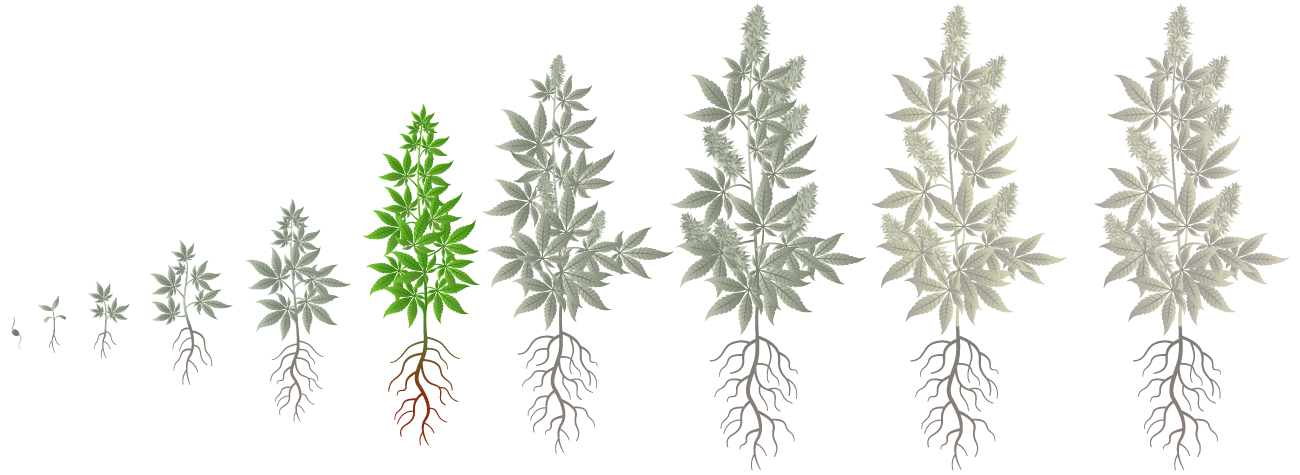
| Parameter | Ideal range |
| Water pH (Soil) | 6.0–6.5 |
| Water pH (Coco Coir) | 5.7–6.2 |
| Water pH (Hydroponics) | 5.5–6.0 |
| EC Soil (mS/cm) | 1.4–1.6 |
| EC Coco Coir (mS/cm) | 1.6–1.8 |
| EC Hydroponics (mS/cm) | 1.8–2.0 |
| Day Temperature (°C/°F) | 24–28°C / 75–82°F |
| Night Temperature (°C/°F) | 20–24°C / 68–75°F |
| Root Zone Temperature (°C/°F) | 20–24°C / 68–75°F |
| Leaf Surface Temperature (°C/°F) | 24–26°C / 75–78°F |
| Related Humidity (RH%) | 50–60% |
| VPD (kPa) | 0.8–1.2 |
| Optimal CO₂ (ppm) | 800–1200 |
| PAR (μmol/m²/s) | 600–900 |
| Lights Hrs/Day | 18–20/6 |
| Light Intensity (%) | 80–100 |
| Light Distance (cm/in) | 20–40 cm / 8–16 in |
| Substrate Moisture | Alternating moist and dry periods |
| Primary Nutrients | N, P, K (high) |
| Secondary Nutrients | Ca, Mg, S (high) |
| Micronutrients | Fe, Zn, Mn, B, Cu, Mo |
| N-P-K | 4–2–3 |
| LST | ScrOG, Bending, Tying |
| HST | Lollipopping, Topping |
| Medium | Frequency | Volume (ml/L) | Runoff % |
| Soil | Every 2–3 days | 300–450 | 10–15% |
| Coco Coir | Daily | 350–500 | 15–20% |
| Hydroponics | Continuous | Maintain aeration | Ensure reservoir |
During this phase, nitrogen levels should be reduced slightly while phosphorus and potassium are gradually increased to support root and flower site development. Calcium and magnesium remain vital for cellular strength and photosynthesis.
| Milestones | ⬜ | Height reaches 60–90 cm (24–36 in), depending on the strain. |
| ⬜ | Canopy fully trained and evenly spread. | |
| ⬜ | Roots well-established to handle flowering nutrient demands. | |
| Checklist | ⬜ | Last structural training completed (ScrOG, tying, bending). |
| ⬜ | Nutrients adjusted for pre-flowering transition. | |
| ⬜ | Final defoliation or lollipopping performed. | |
| ⬜ | Environmental parameters optimised and stable. |
The late vegetation phase is the final stage before pre-flowering, where plants solidify their structure and prepare for the flowering process.
Your plant will have a robust structure with fully developed branches and healthy, vibrant foliage.
Keep an 18/6 light cycle (18 hours of light and 6 hours of darkness) for photoperiod plants.
Yes, reduce nitrogen slightly and increase phosphorus and potassium to prepare for flowering.
Prune lower branches and use LST or ScrOG techniques to maintain airflow and light penetration.
Lollipopping involves removing lower growth that won't produce quality buds. It is ideal during late vegetation.
Maintain temperatures between 24–28°C (75–82°F) and humidity levels at 50–60%.
Yes, but avoid stressful techniques like topping or super cropping late in the phase.
Water every 3–5 days in soil or daily in coco coir, ensuring proper runoff to prevent salt buildup.
Check for a fully developed root system, strong stems, and an even canopy to confirm readiness.
Maintain an EC of 1.6–1.8 mS/cm to provide adequate nutrients without overfeeding.
Yes, avoid topping late in this phase to prevent delays in flowering.
Monitor for dark green leaves and reduce nitrogen if needed to avoid toxicity.
Increase light intensity to 80–100% and keep the distance at 20–40 cm (8–16 in) from the canopy.
Gradually reduce nitrogen levels and increase phosphorus and potassium in the final week of late vegetation.
Wilting, discolouration, or stunted growth are common signs of stress requiring immediate attention.
Yes, trellis nets help manage vertical growth and ensure an even canopy before flowering.
Νοταε
Topics
late veg, pre-flower, light cycle, final training, nitrogen
Focus Keyword
late vegetation phase | cannabis growth stage
Description
The final preparations before flowering. Adjustments to training, nutrients and light cycle that determine what your plant will become.
Join early.
Keep the
archive open.
The VADEMECUM is not just a book anymore. It is becoming a living archive of guides, tools, notes and practical plant knowledge.
Free member access. Join early. Keep the archive open.
The VADEMECUM is becoming a living archive of practical plant knowledge.
Free member access.