

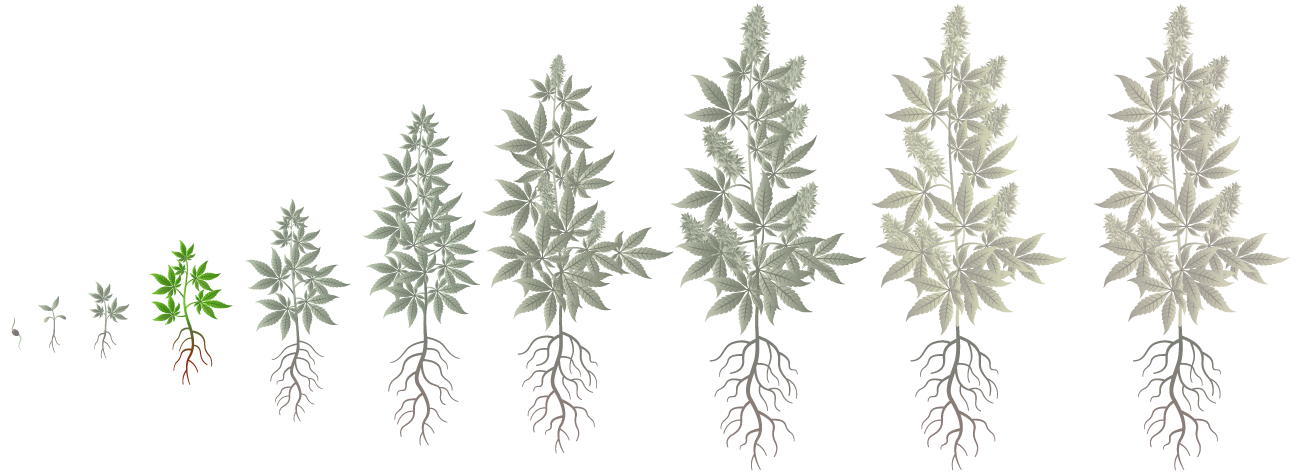
The Early Vegetation Phase is when cannabis begins its first major growth spurt. Roots deepen, stems strengthen, and new foliage emerges. This phase establishes the structural foundation for the plant, making it an ideal time to introduce Low-Stress Training (LST) and gradually increase nutrient levels to support robust growth.
| Parameter | Ideal range |
| Water pH (Soil) | 6.0–6.5 |
| Water pH (Coco Coir) | 5.7–6.2 |
| Water pH (Hydroponics) | 5.5–6.0 |
| EC Soil (mS/cm) | 0.8–1.0 |
| EC Coco Coir (mS/cm) | 1.0–1.2 |
| EC Hydroponics (mS/cm) | 1.2–1.4 |
| Day Temperature (°C/°F) | 24–28°C / 75–82°F |
| Night Temperature (°C/°F) | 20–24°C / 68–75°F |
| Root Zone Temperature (°C/°F) | 20–24°C / 68–75°F |
| Leaf Surface Temperature (°C/°F) | 24–26°C / 75–78°F |
| Related Humidity (RH%) | 60–70% |
| VPD (kPa) | 0.8–1.2 |
| Optimal CO₂ (ppm) | 800–1000 |
| PAR (μmol/m²/s) | 400–600 |
| Lights Hrs/Day | 18–20/6 |
| Light Intensity (%) | 40–60 |
| Light Distance (cm/in) | 30–50 cm / 12–20 in |
| Substrate Moisture | Alternating moist and dry periods |
| Primary Nutrients | N, P, K (medium) |
| Secondary Nutrients | Ca, Mg, S (medium) |
| Micronutrients | Fe, Zn, Mn, B, Cu, Mo |
| N-P-K | 3-1-3 |
| LST | Bending, Tying |
| HST | Topping |
| Medium | Frequency | Volume (ml/L) | Runoff % |
| Soil | Every 2–3 days | 200–300 | 10–15% |
| Coco Coir | Daily | 250–350 | 15–20% |
| Hydroponics | Continuous | Maintain aeration | Maintain reservoir |
Nitrogen plays a dominant role during this phase, promoting leaf and stem development. Secondary nutrients like calcium and magnesium support structural strength, while micronutrients assist enzymatic processes and photosynthesis. Gradual increases in NPK levels (4-2-3) are critical for meeting the plant’s needs without overfeeding.
| Milestones | ⬜ | Plant height reaches 15–25 cm (6–10 in). |
| ⬜ | Development of 4–8 sets of healthy leaves. | |
| ⬜ | Initial lateral branch growth visible. | |
| Checklist | ⬜ | First successful LST applied. |
| ⬜ | Topping completed for bushier growth. | |
| ⬜ | Nutrient concentrations adjusted to support larger plants. | |
| ⬜ | Pests and diseases checked and addressed if present. |
It’s the phase when cannabis begins its first significant growth spurt, focusing on leaf, root, and stem development.
It typically lasts 2–3 weeks, depending on strain and growing conditions.
Use lights with higher intensity (200–400 μmol/m²/s) and a blue spectrum to promote vegetative growth.
Water every 2–3 days for soil and daily for coco coir, allowing slight drying between waterings.
Nitrogen is critical, supported by calcium, magnesium, and micronutrients like zinc and iron.
Maintain temperatures between 22–26°C (72–79°F) and humidity at 60–70%.
Yes, you can begin Low-Stress Training (LST) to encourage even growth and light exposure.
Yellowing may indicate overwatering, nitrogen deficiency, or pH imbalances.
Stretching occurs from insufficient light intensity or the lights being too far from the plants.
Yes, gentle airflow strengthens stems and prevents mould and pests.
Νοταε
Topics
early veg, root development, light schedule, training, feeding
Focus Keyword
early vegetation phase | cannabis growth stage
Description
Roots establishing, leaves multiplying. The early vegetation phase is when your plant finds its rhythm — and when you start to shape it.

Join early.
Keep the
archive open.
The VADEMECUM is not just a book anymore. It is becoming a living archive of guides, tools, notes and practical plant knowledge.
Free member access. Join early. Keep the archive open.
The VADEMECUM is becoming a living archive of practical plant knowledge.
Free member access.