

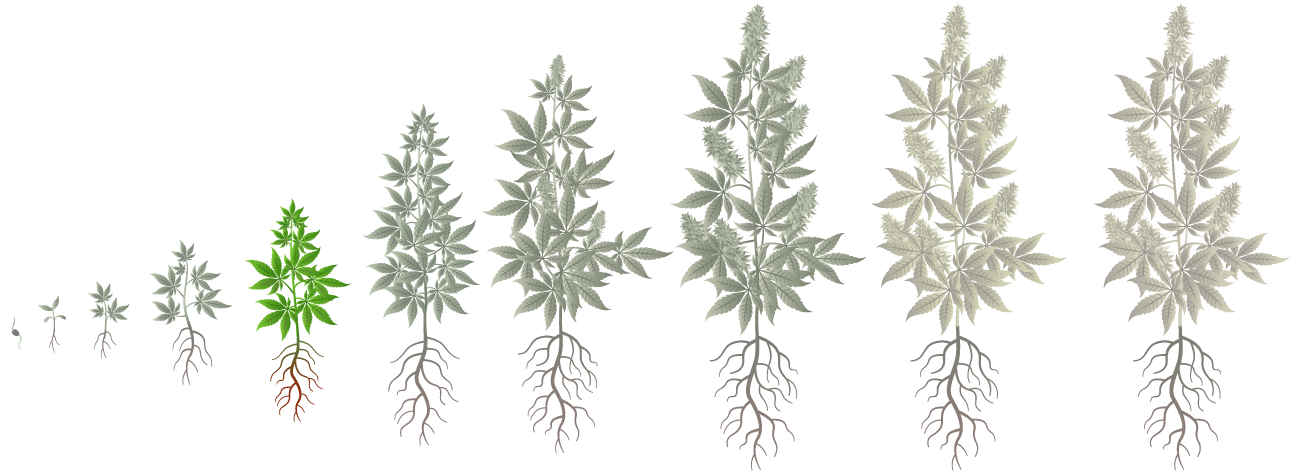
The (Main) Vegetation Phase is a period of vigourous growth where cannabis plants expand both vertically and horizontally. This stage is critical for shaping the plant’s structure through advanced training techniques and ensuring it develops the strength to support heavy flowers in the upcoming phases.
| Parameter | Ideal range |
| Water pH (Soil) | 6.0–6.5 |
| Water pH (Coco Coir) | 5.7–6.2 |
| Water pH (Hydroponics) | 5.5–6.0 |
| EC Soil (mS/cm) | 1.0–1.4 |
| EC Coco Coir (mS/cm) | 1.2–1.6 |
| EC Hydroponics (mS/cm) | 1.4–1.8 |
| Day Temperature (°C/°F) | 24–28°C / 75–82°F |
| Night Temperature (°C/°F) | 20–24°C / 68–75°F |
| Root Zone Temperature (°C/°F) | 20–24°C / 68–75°F |
| Leaf Surface Temperature (°C/°F) | 24–26°C / 75–78°F |
| Related Humidity (RH%) | 50–65% |
| VPD (kPa) | 0.8–1.2 |
| Optimal CO₂ (ppm) | 1000–1200 |
| PAR (μmol/m²/s) | 600–900 |
| Lights Hrs/Day | 18-20/6 |
| Light Intensity (%) | 60–90% |
| Light Distance (cm/in) | 20–40 cm / 8–16 in |
| Substrate Moisture | Alternating moist and dry periods |
| Primary Nutrients | N, P, K (medium) |
| Secondary Nutrients | Ca, Mg, S (medium) |
| Micronutrients | Fe, Zn, Mn, B, Cu, Mo |
| N-P-K | 4-2-3 |
| LST | Bending, Tying, ScrOG |
| HST | Topping, FIMing, Super Cropping |
| Medium | Frequency | Volume (ml/L) | Runoff % |
| Soil | Every 2–3 days | 300–400 | 10–15% |
| Coco Coir | Daily | 350–450 | 15–20% |
| Hydroponics | Continuous | Maintain aeration | Maintain reservoir |
Nitrogen remains the dominant nutrient for this phase, driving leaf and stem development. Calcium and magnesium support strong structural growth, while micronutrients like zinc and manganese are essential for photosynthesis and enzymatic processes.
| Milestones | ⬜ | Plant height reaches 30–60 cm (12–24 in). |
| ⬜ | Canopy evenly spread and trained for optimal light exposure. | |
| ⬜ | Root system well-established, supporting vigourous above-ground growth. | |
| Checklist | ⬜ | LST techniques implemented and adjusted as needed. |
| ⬜ | Defoliation performed to enhance airflow and light penetration. | |
| ⬜ | Nutrient concentrations gradually increased to meet plant demands. | |
| ⬜ | Pests and diseases monitored and managed effectively. |
It’s the period where cannabis grows rapidly in size, both vertically and horizontally, focusing on foliage and stem development.
This phase can last 2–5 weeks, depending on the strain and desired plant size.
Nitrogen is essential, along with calcium and magnesium, for healthy leaf and stem growth.
Water every 2–3 days in soil or daily in coco coir, ensuring proper drainage to prevent overwatering.
Provide a light intensity of 600–900 μmol/m²/s, with a focus on the blue spectrum for vegetative growth.
Yes, this is a great time to continue LST to shape the canopy and improve light distribution.
You can remove large fan leaves that block light to lower branches, but avoid over-defoliation.
Inspect plants regularly and use preventive measures like neem oil or beneficial insects.
This could indicate heat stress or low humidity. Check environmental conditions.
Switch to the flowering phase when plants have reached the desired size and structure.
Use techniques like topping, FIMing, or super cropping to control vertical growth & encourage lateral branching.
Yes, ScrOG nets are highly effective for training branches and optimizing light exposure.
Silica strengthens cell walls, making stems more resistant to stress and capable of supporting heavier buds later.
Monitor for signs like yellowing leaves (nitrogen deficiency) or purple stems (phosphorus deficiency).
Use oscillating fans to circulate air evenly and prevent stagnant humidity pockets.
Yes, combining these techniques maximises canopy management and improves yield potential.
Look for dark green leaves, leaf tip burn, or slow growth, and reduce nutrient concentration accordingly.
Νοταε
Topics
vegetation, canopy, training, LST, nutrients, light, growth
Focus Keyword
main vegetation phase | cannabis growth stage
Description
Maximum growth, maximum attention. The main vegetation phase is where training, feeding and environment come together — or come apart.
Join early.
Keep the
archive open.
The VADEMECUM is not just a book anymore. It is becoming a living archive of guides, tools, notes and practical plant knowledge.
Free member access. Join early. Keep the archive open.
The VADEMECUM is becoming a living archive of practical plant knowledge.
Free member access.