
HERBARIUM
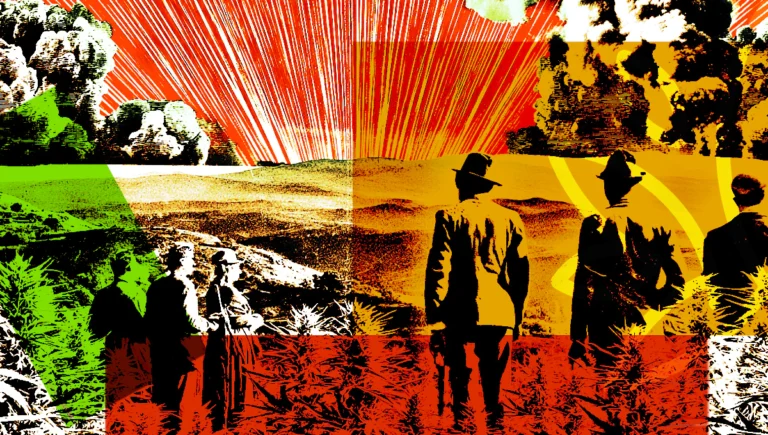
Why are the Jews
in cannabis?
Some questions arrive already poisoned.
That is not a serious market question.
It is an old prejudice looking for a new industry.
The serious question is:
Why did Israel become important
in medical cannabis science, regulation and agritech?
That question deserves an answer.
First, the trap.
Israel did not become important in cannabis
because it legalised recreational cannabis early.
It did not.
Israel did not build its cannabis position through an early commercial adult-use market. Its influence came mainly through medical cannabis, research, regulation and agritech.
So if someone says, “They got ahead because they legalised”, the answer is:
No. They got ahead
because they studied.
Israel’s central cannabis advantage
begins with science.
Raphael Mechoulam and colleagues helped define modern cannabinoid science by characterising CBD and THC in the 1960s and later contributing to the discovery of anandamide and 2-AG.
That matters.
Cannabis was not simply “known” in Israel. It was studied there at a level that shaped global cannabinoid science.
The plant did not enter through folklore alone.
It entered through chemistry.
Israel’s medical cannabis programme
began early.
Israel developed an early medical-cannabis framework that connected patients, doctors, researchers, cultivation standards, pharmacies, regulators and clinical data.
Not perfect. Not free of commercial pressure. But serious.
A country does not need recreational dispensaries to build medical cannabis knowledge.
It needs permission
to research, treat, regulate and improve.
And how did they learn this
in the desert?
That question sounds funny until it becomes stupid.
Israel invested heavily in agricultural technology because water scarcity, climate and land pressure made agriculture a technical problem. Drip irrigation, fertigation, protected cultivation, seed work, sensors and desert agriculture became part of that infrastructure.
So when cannabis entered that ecosystem,
it did not enter an empty field.
It entered a country
already trained to treat plants as controlled biological systems.
That is not conspiracy.
That is infrastructure.
There is basis for the “no-high” cannabis story,
but again we must speak carefully.
In 2012, reports described Tikun Olam’s Avidekel as a CBD-rich, very low-THC cultivar. Contemporary reporting presented it as an early and highly visible example of low-THC medical breeding, while also acknowledging that global “first” claims were difficult to verify.
So the clean version is:
Israel was early and visible
in CBD-rich / low-THC medical cannabis breeding.
But “first” claims should be handled cautiously.
The conspiracy appears
because people see success
and skip the infrastructure.
They do not see the laboratories, decades of research, medical programme, agritech base, regulatory work or chemistry.
They see a group they already suspect.
Then they call suspicion analysis.
That is not analysis.
It is laziness with an enemy.
Israel’s cannabis role should
be studied critically.
Companies, markets, prices, exports, medical access, corporate concentration and national branding can all be criticised.
Ethnicity is not an explanation.
If someone wants to understand Israeli cannabis, the path is clear:
Mechoulam. Hebrew University. Medical cannabis since the early 1990s. Agritech. Water scarcity. Controlled cultivation. Clinical research. Regulatory infrastructure. Export ambition. Patient demand. High-tech culture…
That is the story.
Not bees around money.
The vulgar version says:
They ran where the money was.
The educated version says:
They were already standing where the science,
medicine and agritech met.
That is why they moved fast when cannabis became visible.
The lesson is not ethnic. The lesson is educational:
Study early. Build infrastructure.
Take plants seriously before the market arrives.
Factual Note
Israel became influential in cannabis primarily through cannabinoid science, medical regulation and agricultural technology rather than through early commercial adult-use legalisation. Raphael Mechoulam and colleagues made foundational contributions to the study of THC, CBD and the endocannabinoid system.
Israel also developed an early medical-cannabis framework and brought existing expertise in irrigation, fertigation, greenhouse cultivation and controlled agriculture into cannabis production.
Claims that Israel or Jewish people entered cannabis through secret coordination or ethnic advantage are antisemitic conspiracy narratives, not serious explanations. Specific companies, regulations and market structures may be criticised through evidence; ethnicity is not evidence.
A living archive of cannabis—its cultivation in practice and its traces across science, culture, language, power and memory.
Join early.
Keep the archive open.
The VADEMECUM is becoming a living archive of guides, tools, notes and practical plant knowledge.
Free member access. Join early. Keep the archive open.
Join early.
Keep the
archive open.
The VADEMECUM is not just a book anymore. It is becoming a living archive of guides, tools, notes and practical plant knowledge.
Free member access. Join early. Keep the archive open.
The VADEMECUM is becoming a living archive of practical plant knowledge.
Free member access.