
HERBARIUM
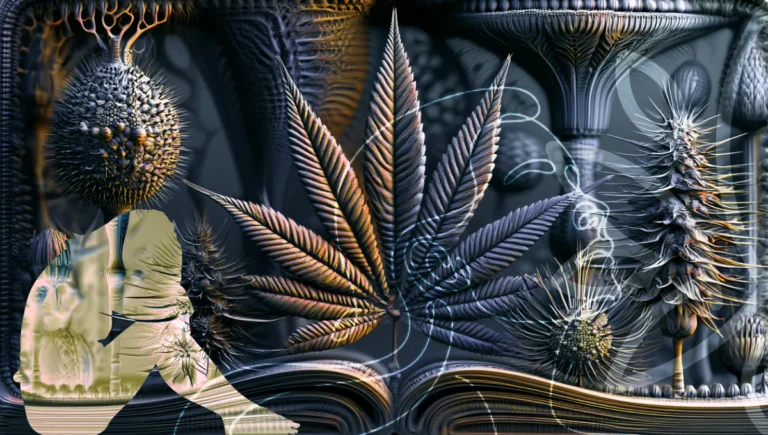
A plant does not become culture by existing.
It becomes culture through labour.
Cannabis history often remembers the loudest figures.
The lawmaker and the doctor.
The dealer, policeman and outlaw.
The breeder, entrepreneur and activist with a microphone.
But the plant also passed through quieter hands.
Hands that spun fibre and wove cloth.
Hands that prepared medicine and cared for the sick.
Hands that kept households dressed, patients fed, children alive and communities functioning before anyone called it cannabis policy.
This is the hidden labour of the plant.
For centuries, hemp belonged to the world of textile work. Like flax and other bast fibres, it required a long chain of cultivation and processing before it became thread, cloth, rope, sacks or household material.
Gender divisions varied by place and period. But in many household textile economies, women carried central responsibilities for spinning, weaving and parts of fibre preparation. Some were unpaid household workers; others were hired specifically to process hemp.
Their labour was skilled, repetitive and economically necessary — even when the archive classified it as ordinary domestic duty.
This is not romantic.
It was skilled, physical and time-consuming work.
The archive often preserves the crop more clearly than it preserves the worker. It tells us hemp was used for rope, cloth, paper and sail. It records laws, yields, exports and industries. But the person turning stalk into thread often disappears behind the finished material.
That disappearance matters.
Because a plant does not become culture by existing.
It becomes culture through labour.
Women’s cannabis history is not only textile history. It is also care history.
In the late 20th century, medical cannabis reform was shaped not only by lawyers, scientists and patients’ rights organisations, but by caregivers — many of them women — who acted because the people in front of them were suffering.
Mary Jane Rathbun, known as Brownie Mary, became a prominent figure in San Francisco’s medical cannabis movement during the AIDS crisis.
From 1984, she volunteered with AIDS patients at San Francisco General Hospital. She also baked and distributed cannabis brownies to people living with severe illness, while repeated arrests brought public attention to her work and to the wider campaign for medical access.
She was not a laboratory or a corporation. Her importance was cultural and political: she made it harder to discuss cannabis only through vice and punishment while ignoring patients and care.
That is labour too.
Not fibre labour.
Care labour.
A different kind of work around the same plant.
Decades later, families facing severe childhood epilepsy brought another form of care work into public view.
Charlotte Figi, who lived with Dravet syndrome, and her mother Paige became central figures in that discussion after appearing in CNN’s 2013 documentary Weed, presented by Sanjay Gupta. Their story gave high-CBD, low-THC cannabis preparations extraordinary public visibility.
It should be remembered as a powerful case of testimony and advocacy, not as clinical proof for every product sold under the name CBD.
This does not make every medical cannabis claim true.
LIBERA HERBA should never turn suffering into proof. Testimony can expose a neglected problem and create pressure for research, but it cannot replace controlled evidence.
Cannabis history still cannot be written only from above. Policy and research often begin to move when private pain becomes public testimony.
A mother beside a child in crisis.
A caregiver watching a patient deteriorate.
A nurse, cook, friend or activist deciding that the law has become less humane than the need in front of them.
These are not decorative stories.
They are part of the evidence of why the plant returned to public argument.
Women also carried cannabis through activism, education, science, business and community work. They organised patient networks, challenged arrests and stigma, and entered cultivation, testing, advocacy and policy.
Others entered the record through punishment rather than recognition. Drug enforcement could threaten employment, housing, family stability, custody and freedom.
That last point must not be softened.
Women were not only helpers in cannabis history.
They were also targets.
Caregivers could be criminalised.
Mothers could be judged.
The plant did not touch all women equally.
Class, race, economic security, immigration status and motherhood could all change the consequences of criminalisation.
This is why LIBERA HERBA should avoid the easy poster version of “women in cannabis”. The real history is stronger.
Women are not a branding category.
They are not an industry panel.
They are not a month.
They are part of the labour record.
Fibre and medicine.
Care and risk.
Activism, knowledge and survival.
The plant’s history is full of visible leaves and invisible hands.
This article is for the hands.
Factual Note
Women’s work with hemp and cannabis has varied substantially across time and place. Historical studies nevertheless document women participating in domestic spinning and weaving, agricultural work and paid hemp processing. It is therefore more accurate to describe women as central to many regional fibre economies than to assign all hemp work universally to one gender.
Mary Jane “Brownie Mary” Rathbun volunteered with AIDS patients at San Francisco General Hospital from the 1980s and distributed cannabis brownies to seriously ill people. Her arrests and advocacy made her a visible figure in the emerging medical cannabis movement.
Charlotte and Paige Figi appeared in CNN’s 2013 documentary Weed, bringing intense public attention to high-CBD cannabis preparations and Dravet syndrome. Their experience was personal testimony rather than a clinical trial. In 2018, the FDA approved the purified cannabidiol medicine Epidiolex for seizures associated with Dravet syndrome and Lennox–Gastaut syndrome after formal clinical evaluation.
These histories show how textile labour, caregiving and patient advocacy influenced cannabis culture. They should neither be romanticised nor treated as substitutes for evidence about the safety and effectiveness of particular medical products.
A living archive of cannabis—its cultivation in practice and its traces across science, culture, language, power and memory.
Join early.
Keep the archive open.
The VADEMECUM is becoming a living archive of guides, tools, notes and practical plant knowledge.
Free member access. Join early. Keep the archive open.
Join early.
Keep the
archive open.
The VADEMECUM is not just a book anymore. It is becoming a living archive of guides, tools, notes and practical plant knowledge.
Free member access. Join early. Keep the archive open.
The VADEMECUM is becoming a living archive of practical plant knowledge.
Free member access.