
HERBARIUM
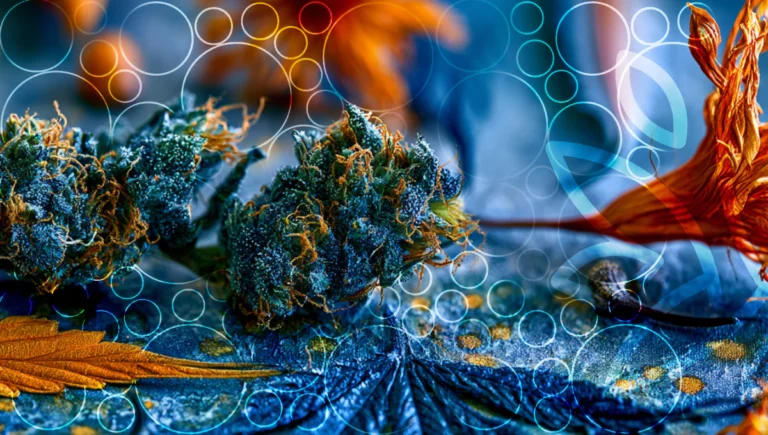
Cannabis has always been
photographed badly.
Not badly in the aesthetic sense. Badly in the educational sense.
For years, the plant was shown as glamour: frost, colour, swollen flowers, purple leaves, macro trichomes, Instagram resin, harvest porn. Beautiful, yes. Useful, sometimes.
A photograph can show beauty.
It cannot always show truth.
The next step is not only better photography.
It is better seeing.
A grower can learn a great deal
by looking closely.
Leaf posture. Internodal spacing. Colour shifts. Tip burn. Turgor. Pest marks. Mould risk. Trichome maturity. Flower density. Uneven canopy behaviour. Signs of water stress. Signs of overfeeding. Signs of environmental imbalance.
Even magnification teaches. A jeweller’s loupe, a microscope, a good macro lens or repeated close visual inspection can turn the plant from object into evidence.
But modern tools are pushing this further.
Near-infrared spectroscopy, portable cannabinoid testing, moisture measurement, water-activity testing and plant imaging are beginning to move parts of laboratory thinking closer to the grower.
Not completely. Not cheaply. Not perfectly.
But enough to change the conversation.
The eye is no longer alone.
Near-infrared spectroscopy
does not “see” the plant
the way a camera sees it.
It shines light into or onto a sample and reads how the material absorbs and reflects that light. Different chemical compositions leave different spectral patterns. With calibration against laboratory data, those patterns can be used to estimate cannabinoids, moisture, sometimes terpenes and other quality markers.
This is not magic. It is comparison.
The device does not know cannabis because it has a soul. It knows cannabis because enough samples were measured, modelled and compared.
That is powerful.
It is also the reason calibration, sample preparation, database quality and method limits matter.
A portable analyser is not a priest.
It is a trained guess with expensive optics.
For a hobby grower, these tools
may be unnecessary luxury.
For a breeder, producer, processor, medical supplier, serious educator or quality-focused cultivator, they can change decisions.
This is where the technology becomes educational.
It does not only answer
“How much THC?”
That is the smallest question.
The better question is:
What is the plant showing
that my eyes cannot measure?
The old macro obsession often waits
until harvest.
Useful, but too narrow.
A serious visual practice begins earlier.
Walk the plant visually. Look under leaves. Look at petioles. Look at new growth. Look at old growth. Look at the lower canopy. Look at wet zones. Look near fans. Look near fabric walls. Look at root behaviour where visible. Look at flower density before it becomes rot. Look at irrigation effects before the root zone becomes a problem.
A visual walk is not decoration.
It is inspection.
And when visual inspection meets measurement,
the grower becomes harder to fool.
These tools can be expensive.
But expensive compared with what?
Compared with a hobby tent? Yes.
Compared with repeated crop loss, bad harvest timing, failed breeding selection, unsafe moisture, inconsistent batches, wrong labels, rejected product or medical-quality uncertainty? Maybe not.
Cost is not only price.
Cost is what ignorance repeats.
A small grower may not need portable spectroscopy. But every grower needs the literacy that spectroscopy represents:
Do not turn a number into a religion.
Cannabis education should teach
seeing in layers.
This is not Instagram. This is plant literacy.
The beautiful bud shot asks for applause.
The serious image asks a question.
But each can help, if the grower knows what he is asking.
The future of cannabis education is not only growing better.
It is seeing better.
Factual Note
Near-infrared spectroscopy estimates sample properties by measuring how material absorbs and reflects light. Its accuracy depends on calibration quality, reference laboratory data, sample preparation and the limits of the model used.
Portable instruments may support screening or quality-control decisions, but they do not automatically replace validated laboratory testing. Visual inspection, magnification, environmental records and chemical analysis answer different questions and should not be treated as interchangeable.
Moisture content and water activity are separate measurements. Both can matter during drying, storage and quality control, but they describe different properties of the sample.
A living archive of cannabis—its cultivation in practice and its traces across science, culture, language, power and memory.
Join early.
Keep the archive open.
The VADEMECUM is becoming a living archive of guides, tools, notes and practical plant knowledge.
Free member access. Join early. Keep the archive open.
Join early.
Keep the
archive open.
The VADEMECUM is not just a book anymore. It is becoming a living archive of guides, tools, notes and practical plant knowledge.
Free member access. Join early. Keep the archive open.
The VADEMECUM is becoming a living archive of practical plant knowledge.
Free member access.