
—orig. developed through MOICANNA
– originally developed through MOICANNA
HEBRARIUM

Cannabis cultivation did not change in a straight line.
It turned.
The history of cannabis cultivation
is not only a history of better plants.
It is a history of better questions.
At first, cannabis belonged
to the wind.
Male plants released pollen. Female plants made seed. Populations crossed, adapted, moved and survived. The plant did not care about sinsemilla, cannabinoids, flavour, uniformity or market categories. It cared about reproduction.
The first great cultivation shift was selection.
Humans began choosing plants for fibre, seed, medicine, resin, height, stem quality, flowering time, aroma, potency, adaptation and usefulness. That changed cannabis from a wild or semi-wild population into a crop shaped by human preference.
But we should be careful with one common myth: sinsemilla is often presented as an ancient universal secret. It is safer to say that deliberate removal of males and cultivation of seedless female flowers became a major modern technique in high-potency cannabis production. George Washington’s 1765 diary notes about separating male and female hemp are real, but they should not be inflated into proof that he was producing modern sinsemilla.
Better lesson:
The first technology was not a machine.
It was selection.
The fibre turn: from hand labour
to mechanisation.
The plant was useful, but the labour was heavy.
The decorticator belongs here. George W. Schlichten’s machine and the later “billion-dollar crop” moment are real, though they should not be turned into a suppressed miracle that would have replaced modern industry. A good historical reading treats the decorticator as a serious attempt to solve a real bottleneck: separating bast fibre from woody hurd at scale. Points History’s treatment of Schlichten is useful precisely because it resists the conspiracy version while preserving the importance of the machine.
Better lesson:
A plant becomes industrial
only when someone solves the labour around it.
Modern indoor cannabis
was shaped partly by law.
Prohibition did not create horticultural lighting, hydroponics or controlled environments. Those technologies came from wider horticulture, greenhouse production and plant science. But prohibition gave cannabis growers a reason to hide, miniaturise, intensify and control.
The plant moved into basements, closets, warehouses and sealed rooms.
That changed everything:
This is the irony: illegality pushed some growers into amateur science. Not always good science. Often dangerous science. But still a new relationship with measurement.
Better lesson:
Prohibition did not stop cultivation.
It changed the laboratory.
A seed population contains variation.
A clone preserves a selected individual.
Cloning changed cannabis deeply.
That allows growers to replicate a desirable plant again and again: same female, same structure, same flowering time, same product identity.
But uniformity has a shadow.
If a clone line carries a pathogen, weakness or hidden instability, the whole operation can inherit it. The modern clone economy made genetics portable — and made disease portable too.
That is why today’s clean-stock movement matters.
Better lesson:
A clone is not only copied genetics.
It is copied risk.
Feminised seeds
changed access.
Instead of planting regular seed and removing males, many growers could start with seeds expected to produce female plants. This made small-scale cultivation easier and reduced wasted space.
But feminised is not magic.
It is a breeding strategy based on inducing male flowers on genetically female plants and using that pollen to produce seeds expected to lack a Y chromosome. Stability still depends on genetics, selection and environment. Recent cannabis research continues to explore sex reversal, ethylene pathways and feminised seed production.
Better lesson:
Feminised seed reduced uncertainty,
but it did not abolish biology.
Before measurement, growers guessed.
After measurement, they could still guess
— but now the plant had data witnesses.
Meters changed cultivation culture.
Before measurement, growers guessed. After measurement, they could still guess — but now the plant had data witnesses.
pH meters, EC meters, thermometers, hygrometers, PAR meters, CO₂ sensors, irrigation controllers and data logs changed the grower’s relationship to the room.
But instruments also created a new mistake:
number worship.
The best growers learned that measurement is not control by itself. It is the beginning of better interpretation.
Better lesson:
The instrument gives the reading.
The grower gives it meaning.
Hop latent viroid is one of the modern turns
no serious grower can ignore.
HLVd is an emerging cannabis disease associated with reduced vigour, yield and bud quality. Modern studies describe it as a major threat to cannabis production, and newer diagnostic methods focus on sensitive, high-throughput detection.
The industry response is changing the culture:
Laboratories and clone suppliers already market verified HLVd testing with RT-qPCR, and commercial labs emphasise that incoming clones should be quarantined and screened before entering production spaces.
Recent work has also investigated meristem tip culture with thermotherapy to eliminate HLVd from cannabis cultivars, with success varying by cultivar.
Better lesson:
The future clone is not only labelled by strain.
It is labelled by health status.
The old light question was simple:
How much light?
The new question is better:
How much useful light, at what spectrum, at what time, under what plant response, for what energy cost?
LEDs changed the economics and physics of indoor cultivation: less radiant heat than HPS in many cases, better spectral control, dimming, zoning and integration with automation. But the next turn is not merely “better LEDs”. It is feedback.
Recent crop-science work is exploring chlorophyll fluorescence as a real-time signal for photosynthetic performance and stress, and 2025–2026 studies describe dynamic LED adjustment using real-time chlorophyll fluorescence monitoring or biofeedback control.
This does not mean every cannabis room in 2026 has AI lights that “read the plant minute by minute”. That would be hype.
The careful statement is stronger:
Controlled-environment agriculture is moving from fixed recipes
towards sensor-informed lighting decisions.
Better lesson:
The future light is not simply brighter.
It is more accountable.
For decades, cannabis markets
worshipped THC percentage.
That is changing.
Not disappearing — THC still matters legally, commercially and pharmacologically — but serious quality discussion now includes terpenes, minor cannabinoids, volatile compounds, contaminants, stability, cultivar identity and batch consistency.
Modern analytical chemistry is pushing this forward. Recent work uses GC-MS and related methods to profile terpenes and cannabinoids, including 2025 studies on simultaneous terpene/cannabinoid profiling and GC×GC-MS terpenoid profiling across cannabis chemovars.
But we should not say “THC is obsolete”.
Better:
THC is no longer enough to describe the product.
This is important for medicine, sensory quality, breeding, product consistency and consumer education.
Better lesson:
The future label is not one number.
It is a chemical fingerprint.
Living soil,
no-till, regenerative methods
Compost, mulch, worms, cover crops and microbial thinking are not merely “old ways returning”.
They are a reaction to high-input fragility.
Growers are asking:
Cannabis media writing often overclaims living soil as if it solves everything. It does not. It can fail from poor design, pests, compaction, water mismanagement, bad compost or contamination.
But the turn is real: serious growers are revisiting soil as infrastructure, not dirt. No-till and regenerative cannabis discussions focus on reducing soil disturbance, maintaining living soil food webs and building long-term fertility.
Better lesson:
Living soil is not anti-science.
It is biology asking to be measured differently.
This may be
the most important turn.
Water scarcity, energy cost, fertiliser insecurity and climate instability are changing what “good cultivation” means. A grow that wastes water, dumps nutrient runoff, ignores RO reject and treats condensate as invisible is not advanced. It is immature.
The future grower will need to know:
Better lesson:
The future grower is not the one who uses no water.
It is the one who knows where every litre went.
Legalisation did not cancel
economics.
Mature cannabis markets have faced oversupply, price compression, insolvency and inventory problems. Reports in 2026 continued to describe falling cannabis prices and oversupply pressures; Canada’s wholesale flower prices were reported to have fallen sharply between 2021 and 2025.
The educational lesson is brutal:
Better lesson:
Legalisation opens the door.
Arithmetic decides who stays inside.
HpLVd testing becomes normal
Clean genetics, quarantine, RT-qPCR testing, sanitation protocols and health certificates are becoming part of serious clone and mother-stock culture. Anyone trading genetics without plant-health literacy is becoming a risk.
Tissue culture becomes practical, but not magical
Tissue culture can preserve genetics, clean stock and support pathogen management, but it is not a miracle reset button. Cultivar response varies, contamination is possible, and clean lab practice matters.
Lighting moves towards feedback
Dynamic spectrum, dimming, chlorophyll fluorescence, hyperspectral sensing and automation are moving controlled-environment cultivation from fixed recipes towards plant-response-based management. This is promising, but not every “AI grow light” claim deserves belief.
Chemistry moves beyond THC
Terpene and minor-cannabinoid profiling, volatile analysis, GC-MS, GC×GC-MS and better batch characterisation are becoming more important. The serious future product is not described by THC alone.
Water becomes a design problem
RO reject, condensate recovery, runoff treatment, recirculation, irrigation precision and dryback management are no longer fringe topics. They are survival topics.
Living soil becomes serious only when measured
No-till and regenerative methods will grow, but the serious version will need soil tests, water literacy, pest monitoring, compost quality, biology and records. The lazy version will just become organic bro science.
Data becomes the second crop
Grow logs, sensors, lab reports, disease tests, water reports, environmental records and batch histories will become part of quality. A grow without records will look increasingly amateur.
The dangerous grower
is not the beginner.
The dangerous grower is the person
who stopped updating.
Cannabis cultivation changes because the world around it changes: law, pathogens, energy, climate, tools, markets, water, medical research, analytical chemistry, consumer expectations and ecological limits.
So the real curriculum is not a list.
It is a habit.
Today’s best practice
can become tomorrow’s charming mistake.
That is not discouraging.
That is cultivation.
| Claim | Ancient growers universally mastered sinsemilla. |
| Verdict | Too broad. |
| Better lesson | Human selection is ancient; modern seedless-flower production became especially important in recent high-potency cannabis cultivation. |
| Claim | The decorticator would have replaced modern industry if it had not been suppressed. |
| Verdict | Overclaim. |
| Better lesson | It addressed a real fibre-processing bottleneck, but it was not an industrial messiah. |
| Claim | Indoor growing was invented by cannabis growers. |
| Verdict | False. |
| Better lesson | Cannabis adopted and adapted wider horticultural technologies under pressure from prohibition. |
| Claim | AI lights now read every cannabis plant and optimise terpenes automatically. |
| Verdict | Hype if stated broadly. |
| Better lesson | Sensor-informed lighting and chlorophyll-fluorescence feedback are real research directions, but commercial claims need evidence. |
| Claim | Terpenes have replaced THC. |
| Verdict | False. |
| Better lesson | THC remains important, but chemical profiling is becoming broader and more meaningful. |
| Claim | Living soil means no inputs, no problems, no science. |
| Verdict | False. |
| Better lesson | Living soil needs biology, water literacy, testing and management. |
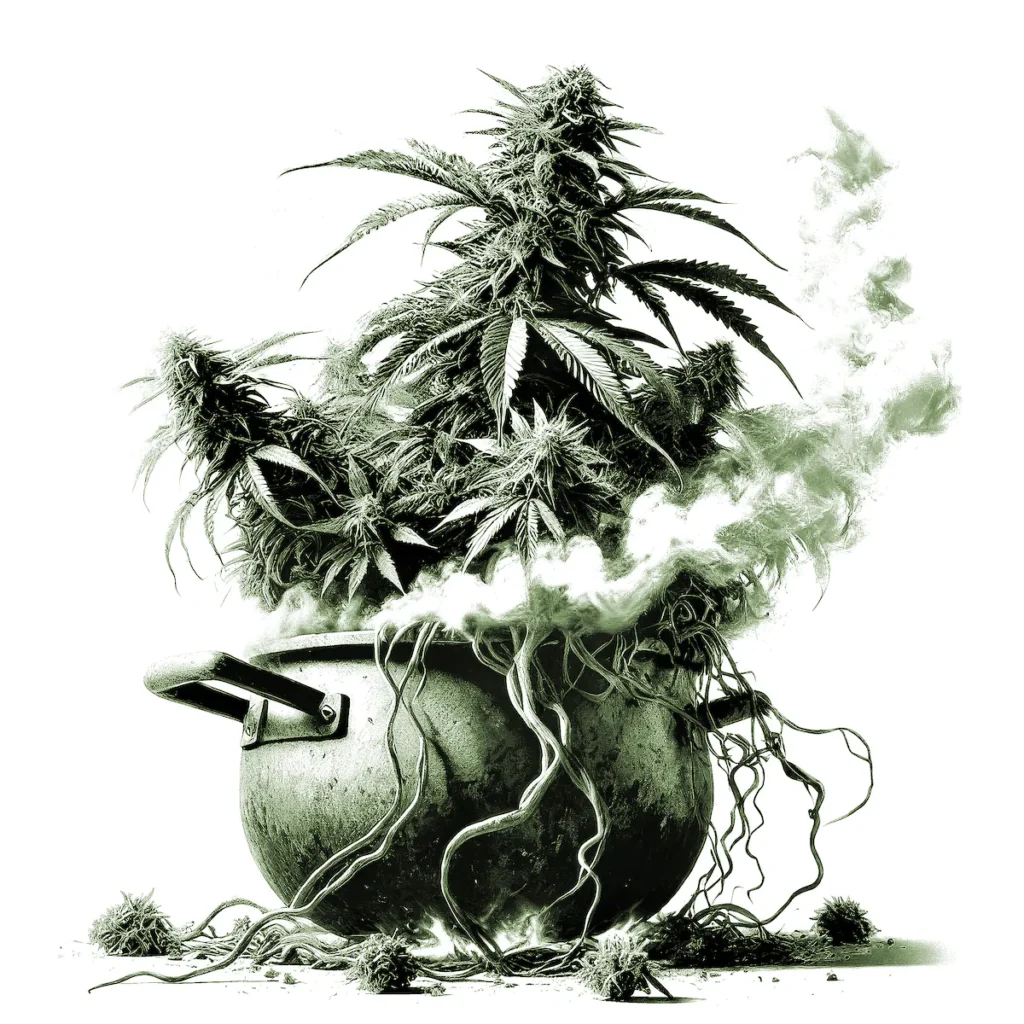
Join early.
Keep the archive open.
The VADEMECUM is becoming a living archive of guides, tools, notes and practical plant knowledge.
Free member access. Join early. Keep the archive open.
Join early.
Keep the
archive open.
The VADEMECUM is not just a book anymore. It is becoming a living archive of guides, tools, notes and practical plant knowledge.
Free member access. Join early. Keep the archive open.
The VADEMECUM is becoming a living archive of practical plant knowledge.
Free member access.