
—orig. developed through MOICANNA
– originally developed through MOICANNA
HEBRARIUM

The plant is already interesting enough
without making it cosmic.
The Scythians are one of the few ancient cannabis stories where text, plant and archaeology almost meet.
That is why they matter.
Herodotus describes hemp growing in Scythian territory, both wild and cultivated. He then notes that the Thracians made hemp garments so similar to linen that an unfamiliar observer might confuse the two.
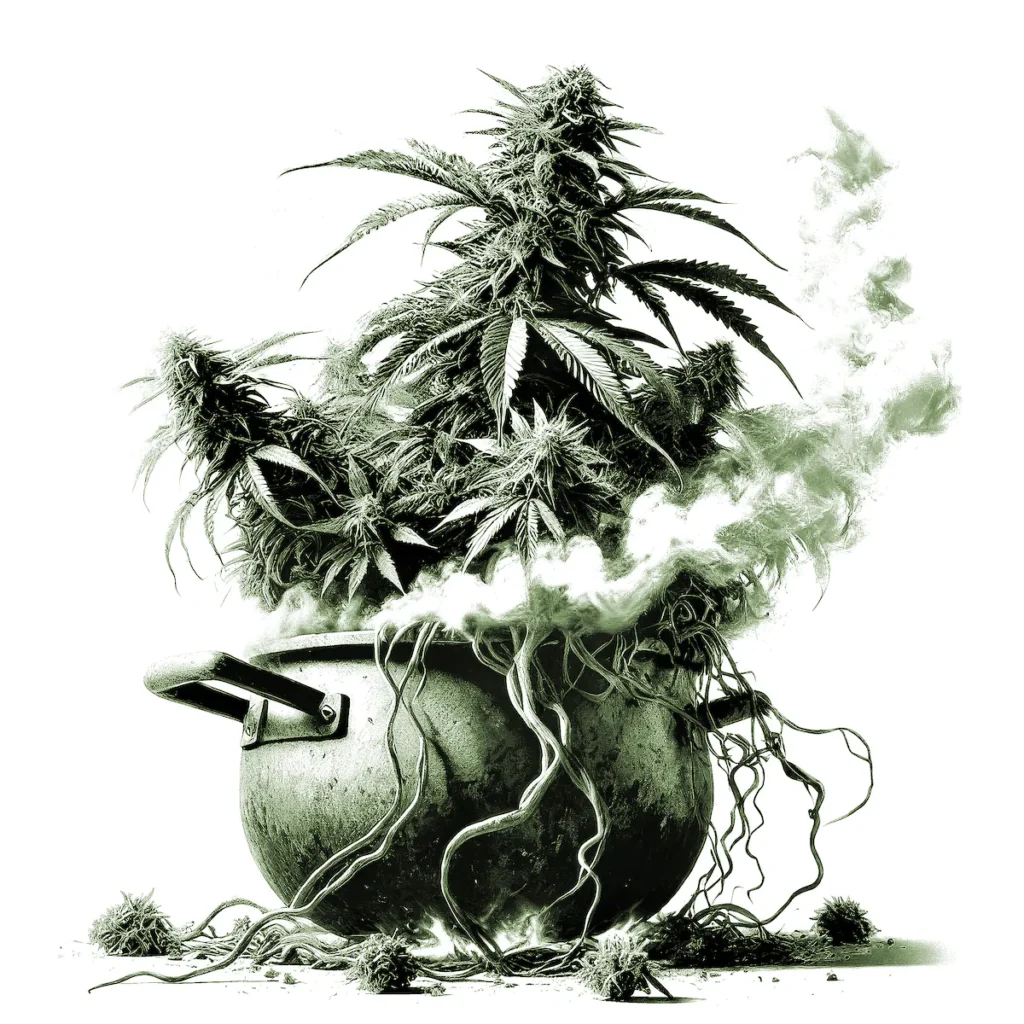
His Scythian account concerns a post-burial cleansing practice. Three poles were covered as closely as possible with woollen felt, red-hot stones were placed inside, and hemp seed was thrown onto them. Herodotus describes the resulting vapour as stronger than a Greek vapour bath and says that the Scythians cried out with pleasure.
This is already unusual.
Cannabis appears not as a modern symbol,
but through fibre, heat, enclosure, vapour and bodily practice.
The story becomes stronger because archaeology answers back.
At the Pazyryk kurgans in the Altai, excavated by Sergei Rudenko during the twentieth century, archaeologists found material that closely parallels parts of the Herodotean account.
A small wooden tent frame was recovered with copper containers holding stones marked by burning and carbonised hemp seeds. A leather pouch from the burial also contained cannabis seeds together with coriander and yellow sweet clover.
This does not mean every word of Herodotus is proven.
Ancient texts are not laboratory reports.
But Pazyryk gives the account archaeological weight. It shows that a related practice existed within the wider Iron Age steppe world: cannabis, heat, portable equipment and burial context.
The parallel is remarkable, but not exact. Pazyryk lies more than 3,000 kilometres north-east of the Caspian steppe described by Herodotus, and the archaeological objects were deposited during burial rather than documenting the post-burial cleansing sequence in his text.
For LIBERA HERBA, the Scythian trace is important because it teaches disciplined interpretation.
Together, text, objects, burning evidence and plant remains create a rare convergence. This is how ancient cannabis history becomes readable.
Not through fantasy.
Through context.
The Scythians do not prove that cannabis was the centre of their civilisation. That would be too much. They were a complex nomadic world of horses, warfare, trade, burial, metalwork, textiles, movement and steppe power.
Cannabis was one thread in that world.
A trace that crossed from Herodotus
into the frozen ground.
Factual Note
In The Histories 4.74–75, Herodotus states that hemp grew both wild and cultivated in Scythian territory. His reference to finely woven hemp clothing concerns the Thracians, not explicitly the Scythians.
Herodotus then describes a Scythian cleansing practice after burial. Three poles were covered with woollen felt, red-hot stones were placed inside, and hemp seed was thrown onto them to produce a dense vapour.
At Pazyryk barrow 2 in the Altai, excavators recovered a small wooden tent frame and copper containers containing burned stones and carbonised hemp seeds. A leather pouch also held cannabis seeds, coriander and yellow sweet clover.
These finds provide a strong archaeological parallel to the account of Herodotus, but not an exact confirmation of it. Pazyryk was geographically distant from the Caspian steppe, and its objects came from a burial deposit rather than a directly observed post-funerary cleansing structure. The evidence supports a related Iron Age steppe practice; it does not show that cannabis defined Scythian or Pazyryk culture as a whole.
Join early.
Keep the archive open.
The VADEMECUM is becoming a living archive of guides, tools, notes and practical plant knowledge.
Free member access. Join early. Keep the archive open.
Join early.
Keep the
archive open.
The VADEMECUM is not just a book anymore. It is becoming a living archive of guides, tools, notes and practical plant knowledge.
Free member access. Join early. Keep the archive open.
The VADEMECUM is becoming a living archive of practical plant knowledge.
Free member access.