
—orig. developed through MOICANNA
– originally developed through MOICANNA
HEBRARIUM
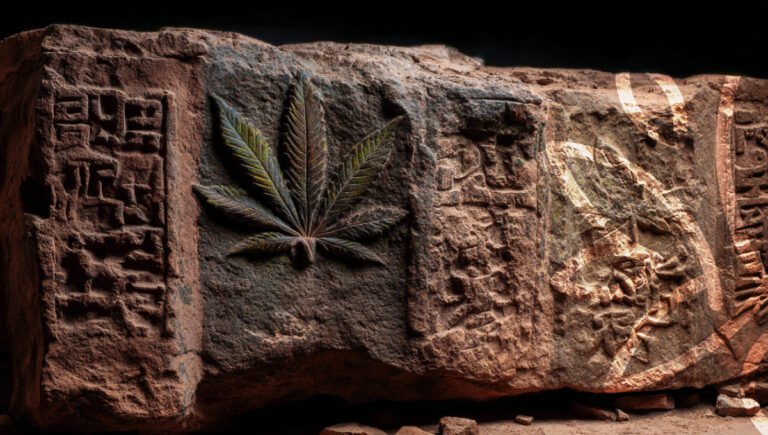
Some plants feed a household.
Others help build an economy.
A 2026 study led by researchers from Shandong University presented new evidence for the place of cannabis within prehistoric agriculture in northern China.
The researchers analysed phytoliths from 132 samples collected at the Beitaishang and Qianzhongzitou settlements in Shandong. The archaeological sequence extended from the Late Neolithic Longshan period into the Early Bronze Age.
It belonged to the core crop assemblage.
Cannabis phytoliths appeared frequently in domestic contexts and often alongside established crops such as millet and rice. The authors argue that, by the Late Neolithic, cannabis had become systematically integrated into the local agricultural economy.
They interpret its principal uses as food or fibre. The phytoliths themselves, however, demonstrate repeated plant presence and processing more securely than they reveal the exact product made from it.
The plant was not simply an isolated find.
It was part of everyday agricultural life.
For LIBERA HERBA, this is an important correction. Cannabis did not enter human history only through ritual, medicine or intoxication. Here it appears within fields, households, agricultural processing and daily subsistence.
Before the plant became a symbol,
it was infrastructure.
A crop people lived with.
A crop people worked.
A crop that helped organise
the human day.
Factual Note
The 2026 study Integrating cannabis into the prehistoric crop assemblage analysed phytoliths from 132 samples taken at Beitaishang and Qianzhongzitou in Shandong, northern China. The deposits span approximately 4500–3400 years before present, from the Late Neolithic into the Early Bronze Age.
Cannabis phytoliths occurred in more than half of the analysed contexts at both sites and frequently appeared alongside millet, rice and other crops. Many came from domestic features, including houses, floors and ash pits.
The authors interpret this distribution as evidence that cannabis had become systematically integrated into the regional crop assemblage by the Late Neolithic, probably for food or fibre. Phytolith evidence establishes repeated plant presence more securely than it identifies a precise use, preparation or level of domestication.
Join early.
Keep the archive open.
The VADEMECUM is becoming a living archive of guides, tools, notes and practical plant knowledge.
Free member access. Join early. Keep the archive open.
Join early.
Keep the
archive open.
The VADEMECUM is not just a book anymore. It is becoming a living archive of guides, tools, notes and practical plant knowledge.
Free member access. Join early. Keep the archive open.
The VADEMECUM is becoming a living archive of practical plant knowledge.
Free member access.