
—orig. developed through MOICANNA
– originally developed through MOICANNA
HEBRARIUM

When cannabis law meets
the plant it forgot to understand.
Cannabis has a strange habit of embarrassing the law.
Not because the plant argues.
Because the law often speaks about cannabis
before it understands the plant.
And then, sometimes, the plant enters the courtroom and the category begins to crack.
This is courtroom botany.
The point is not that courts are foolish. The point is sharper:
when law flattens a plant, reality eventually objects.
In North Carolina, the objection arrived in a plastic bag. In 2025, attorney Benjamin Kull argued before the North Carolina Supreme Court that cannabis smell alone could no longer carry the same legal certainty once lawful hemp entered the same sensory world. He produced a bag of legal hemp to make the problem visible.
That moment worked because it was simple.
Once legal hemp exists beside illegal marijuana, smell becomes a weaker shortcut for legality. The law may want odour to mean one thing. The plant does not cooperate.
This is not theatre for its own sake.
It is evidence made visible.
The baggie did what legal language often fails to do:
it forced the court to look at the plant problem directly.
Half a century earlier, Timothy Leary exposed another contradiction. The Marihuana Tax Act of 1937 required compliance with a tax-and-registration system, but compliance could expose a person to prosecution. In Leary v. United States, the Supreme Court accepted the Fifth Amendment self-incrimination defence.
That case matters because it shows prohibition eating its own paperwork.
The law demanded disclosure.
Disclosure created danger.
The citizen was asked to obey by incriminating himself.
This is the bureaucratic absurdity of cannabis law at its finest:
a plant turned into a form, and the form turned into a trap.
Then comes Diane Monson.
In California, Diane Monson grew six medical cannabis plants lawfully under state law. Federal agents seized and destroyed them because cannabis remained illegal federally. The dispute became part of Gonzales v. Raich, where the Supreme Court upheld federal authority over locally grown, non-commercial medical cannabis.
Six plants became a national question.
Not because six plants could move an economy by themselves.
But because federal power often works by category. If Congress can regulate the larger interstate market, the Court held, it can reach local activity that forms part of that regulatory scheme.
For LIBERA HERBA, the lesson is not only legal. It is educational.
Cannabis exposes the distance between lived reality and legal abstraction.
Same plants.
Four realities.
United States v. Hemani presents another collision: whether the federal firearm ban for unlawful drug users can constitutionally apply where cannabis is legal or tolerated under state law but remains illegal federally.
This is where originalist constitutional analysis becomes almost surreal.
Modern cannabis users are compared with historical rules concerning dangerousness, intoxication and disarmament. The question is whether those older traditions are sufficiently similar to justify modern restrictions.
That is not only a gun case.
It is a time-machine problem.
The court must translate a modern drug category into an older legal world that did not classify cannabis as modern federal law does.
That translation is messy. And the mess matters.
Because cannabis law is full of inherited categories that no longer fit cleanly: hemp versus marijuana, state legality versus federal illegality, smell versus chemistry, medical use versus Schedule I, and personal cultivation versus interstate commerce.
This is why courtroom cannabis stories are not just curiosities.
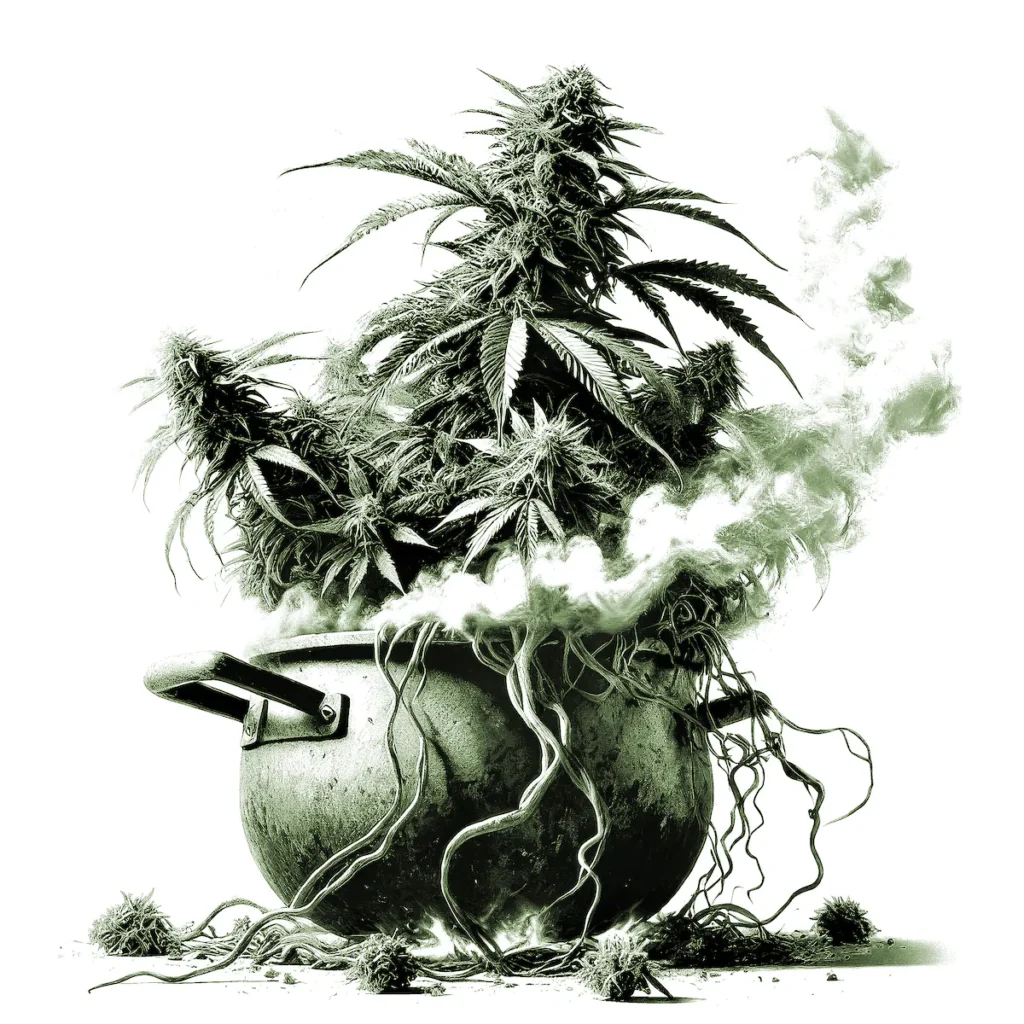
They reveal where the legal system has lost contact with the plant. A judge may not need to be a botanist.
But a legal system that cannot distinguish hemp from marijuana, medicine from contraband, smell from probable cause, or paperwork from self-incrimination will eventually produce absurd results.
The plant does not need to win every case.
It only needs to keep exposing the category error.
For LIBERA HERBA, courtroom botany belongs in the Herbarium because it teaches one of the most important lessons in cannabis education:
But law is not the plant.
And whenever law forgets that, the plant has a way of appearing in court.
Factual Note
Cannabis law has repeatedly produced conflicts between plant biology, sensory evidence and legal classification. Lawful hemp and prohibited marijuana may be difficult to distinguish by smell or appearance alone, which complicates older policing assumptions.
In Leary v. United States (1969), the Supreme Court accepted a Fifth Amendment self-incrimination defence against a charge under the Marihuana Tax Act. In Gonzales v. Raich (2005), the Court upheld federal authority over locally grown medical cannabis despite California law.
United States v. Hemani concerns the constitutional application of federal firearm restrictions to unlawful drug users. Because the case is current, its procedural status and outcome should remain linked to an official court source and updated when necessary.
Join early.
Keep the archive open.
The VADEMECUM is becoming a living archive of guides, tools, notes and practical plant knowledge.
Free member access. Join early. Keep the archive open.
Join early.
Keep the
archive open.
The VADEMECUM is not just a book anymore. It is becoming a living archive of guides, tools, notes and practical plant knowledge.
Free member access. Join early. Keep the archive open.
The VADEMECUM is becoming a living archive of practical plant knowledge.
Free member access.