
HERBARIUM
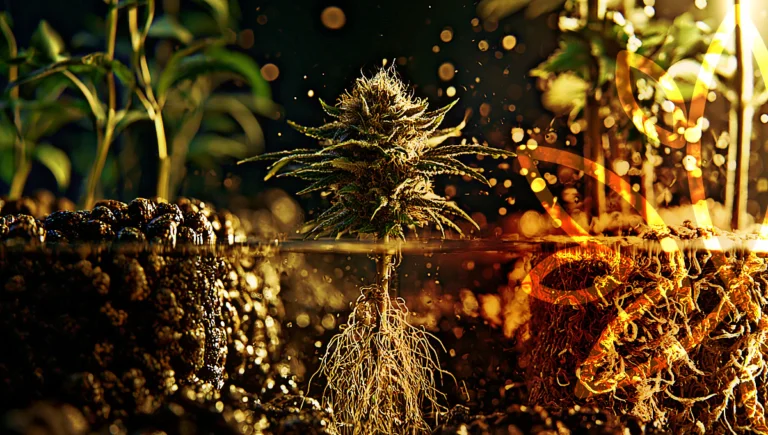
A growing medium is not only a technical choice.
It is a lifestyle choice.
Soil-based mixes, coconut coir, water culture, recirculating hydroponics, blended substrates and automated fertigation can all produce excellent cannabis. None is inherently the best system.
Each changes the physical and chemical conditions around the roots, the grower’s workload and the consequences of a missed irrigation or equipment failure.
For clarity, this article uses coco for container cultivation in coconut coir and hydroponics for water-culture or recirculating systems. Technically, however, coco is also a soilless form of hydroponic cultivation.
The beginner usually asks:
Which medium gives the best yield?
The better question is:
Which medium can I manage well throughout the entire crop cycle?
Because a crop is not a weekend decision.
It is a relationship with a schedule.
Soil is not
automatically easy.
“Soil” is not one standard material. In container cultivation, the word may describe mineral soil, an amended organic mix or a peat-, compost- or coir-based potting substrate that contains little actual field soil.
Any of these can fail through poor structure, unsuitable amendments, excessive salinity, inadequate drainage or incorrect irrigation. A biologically active or compost-rich mix may buffer some changes in water and nutrient availability, but the level of buffering varies greatly.
Good soil does not prevent mistakes.
It may make some mistakes develop more slowly.
For many hobby growers and small gardens, a well-designed soil-based mix can fit daily life more comfortably. It still requires moisture judgement, suitable container size, drainage, root health and an understanding of any nutrients already present in the mix.
It may require fewer daily measurements than an intensively fertigated system, but that depends on the substrate and how it is managed.
Soil can be a garden.
That matters.
Coco is not soil.
This sentence saves crops.
Coconut coir is a soilless substrate whose behaviour depends on particle size, compression, processing, container volume and any materials blended into it. Different coir products can hold very different amounts of water and air.
Irrigation frequency should therefore follow root development, container size, climate and measured dryback — not a universal schedule.
Coco asks for consistent fertigation, suitable drainage, pH and EC monitoring, salt management and awareness of both source water and substrate quality.
Coir also interacts with positively charged nutrients such as calcium, magnesium and potassium. The total nutrient programme must provide an appropriate balance, but that does not mean every coco grow automatically requires a separate “Cal-Mag” product.
Coco rewards attention.
It does not reward romantic neglect.
For some growers, that is ideal. They enjoy routine, measurement and the ability to adjust irrigation and nutrition directly. They are willing to monitor the input solution, the root zone and the behaviour of the crop rather than treating the bagged substrate as ordinary soil.
For others, coco turns the plant into homework.
And not everyone grows cannabis
because they wanted homework.
Hydroponics can provide direct control,
but every system has different failure points.
Deep-water culture, nutrient-film systems, ebb-and-flow, aeroponics and media-supported drip irrigation do not offer the same amount of buffering. Some depend continuously on pumps or aeration; others retain enough moisture to give the grower more time when equipment fails.
Nutrient concentration, solution temperature, pH, oxygen availability, sanitation and water movement can all become critical. In connected or recirculating systems, a local problem may also spread through the shared solution.
Hydroponics can make plant responses faster and corrections more direct. It does not guarantee higher yield, and it can make certain failures develop more quickly.
That may be exactly what a serious grower wants.
It may be exactly what a hobby grower does not need.
Many growers try the
middle road.
Soil with perlite. Soil with coco. Coco blends. Light mixes. Peat-based substrates. Amended inert media. Semi-hydro systems…
These can work beautifully.
But every blend changes the rules.
Changing a blend changes water retention, air-filled porosity, drainage, rewetting behaviour and nutrient buffering.
A mix containing more coarse material may drain faster. A finer or more water-retentive mix may remain wet for longer. But ingredient names alone do not predict behaviour: particle size, proportions, compaction and container geometry also matter.
A “simple mix” is only simple
if you understand what each part changes.
This is the real section.
Not yield. Not theoretical quality.
Not what a forum says.
Ask:
The best medium is not the one with the highest ceiling.
It is the one whose floor you will not fall through.
A system can be better on paper
and worse for your life.
A higher theoretical yield may sound like victory.
But no substrate guarantees that yield. Cultivar, root-zone conditions, irrigation, nutrition, light, climate and grower consistency interact with the medium.
If the system creates constant tension, unexplained swings, late corrections and loss of pleasure, its theoretical advantage may not be an advantage for that grower.
It can also be study, craft, routine, research, curiosity, patience and quiet.
Do not choose a medium
that destroys the reason you started growing.
Soil, coco and hydro are not ranks.
They are commitments.
The grower must choose not only what the plant can grow in.
He must choose what he can live with.
Factual Note
A growing medium influences the balance of water, air and nutrients around the roots. Media sold as soil, peat mix, coconut coir, rockwool or blended substrate may differ substantially in water-holding capacity, drainage, air-filled porosity, salinity and nutrient-buffering behaviour.
Coconut coir is a soilless substrate and can be used within hydroponic fertigation systems. Its properties depend on processing and particle composition. Poorly prepared coir may contain excessive sodium or chloride, while its cation-exchange behaviour can influence calcium, magnesium and potassium management. The need for additional supplementation depends on the complete nutrient formulation and source water.
Hydroponics is a broad category rather than one standard system. The effects of pump failure, aeration loss, temperature change or pH drift depend on whether the system is passive, media-supported, water-culture or continuously recirculating.
No growing medium guarantees superior yield or quality. Experimental cannabis studies indicate that substrate effects can interact with genotype, irrigation and nutrient management. The appropriate medium is therefore the one whose root-zone behaviour the grower can understand, monitor and manage consistently.
A living archive of cannabis—its cultivation in practice and its traces across science, culture, language, power and memory.
Join early.
Keep the archive open.
The VADEMECUM is becoming a living archive of guides, tools, notes and practical plant knowledge.
Free member access. Join early. Keep the archive open.
Join early.
Keep the
archive open.
The VADEMECUM is not just a book anymore. It is becoming a living archive of guides, tools, notes and practical plant knowledge.
Free member access. Join early. Keep the archive open.
The VADEMECUM is becoming a living archive of practical plant knowledge.
Free member access.