
—orig. developed through MOICANNA
– originally developed through MOICANNA
HEBRARIUM

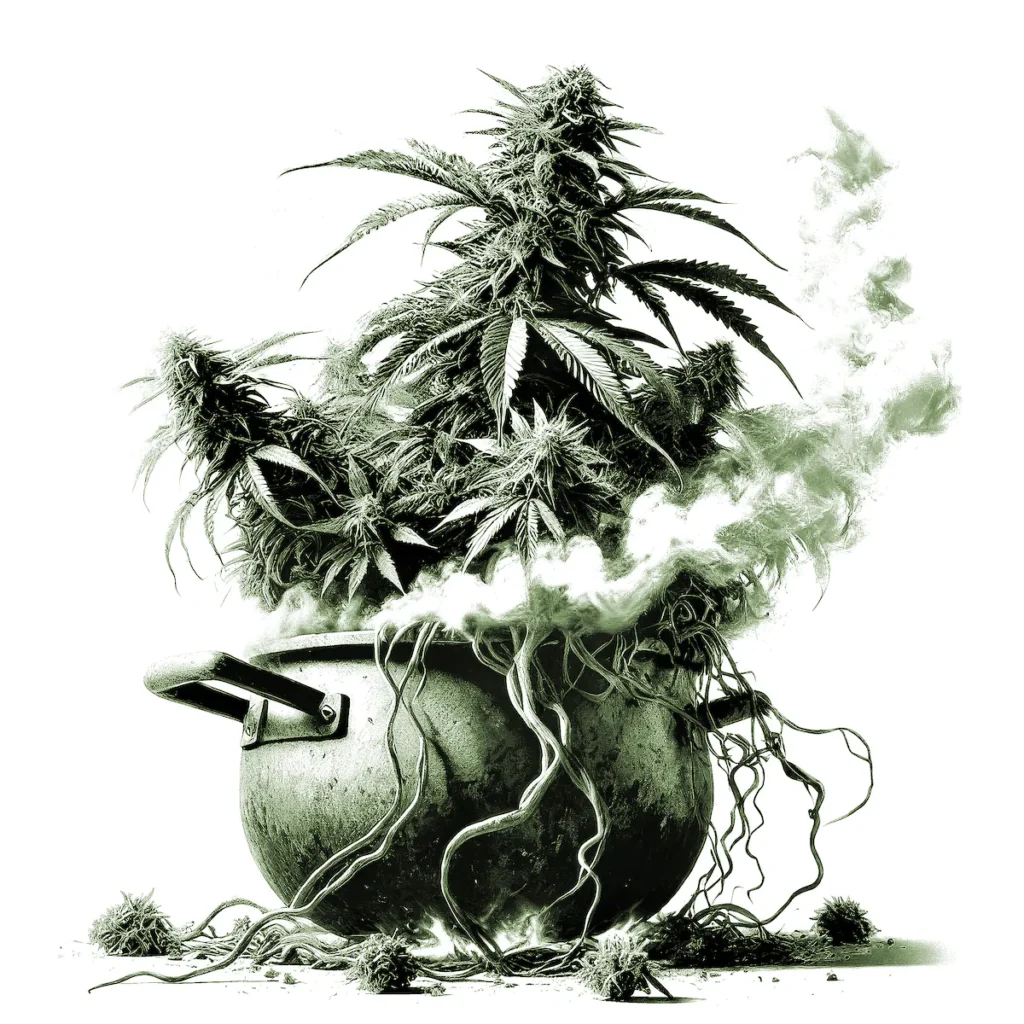
If the Maker, Nature, God, chance, evolution — choose the word you trust — could look at cannabis today, the first reaction might not be anger.
It might be disbelief.
Not at the plant. At us.
Here was a hardy annual: field plant, fibre plant, seed plant, medicine plant and weed in the old agricultural sense—adaptable, persistent and difficult to erase. It could grow in poor places, enter human labour, become rope, cloth, oil, food, paper, medicine, law, song, police file, laboratory sample and cultural argument.
And what did we do?
Perhaps the voice would not thunder.
Perhaps it would simply ask:
“I gave you a plant. Why did you need a planetary bill to grow it?”
That question is not anti-technology.
Technology can be useful and precise. A pH meter is not arrogance. A clean irrigation system can reduce waste. A controlled drying room can protect quality. Laboratory testing can protect patients. A grow log can protect memory from panic. Measurement is not the enemy.
The problem is not knowledge.
The problem is appetite without proportion.
No serious person needs to hate progress.
But progress should be able to look at its own invoice.
Cannabis did not ask to become a shrine, a miracle, a stock-market fever, a legal trap or a laboratory ego contest. Human beings added ambition, fear, money, law, branding and waste.
Then we called the result culture.
If the old voice spoke again, perhaps it would not say, “Do not grow”.
It might say:
And perhaps, with a little humour, it would add:
“The weed was not the problem.
The clever animal with the credit card was”.
That is the uncomfortable lesson.
Cannabis reveals us.
It reveals whether we can care for a living thing without overcontrolling it, use technology without becoming careless with power, build markets without turning every leaf into a price tag, and respect risk without returning to stigma.
The plant does not need worship.
It needs literacy.
It needs growers who understand roots, water, air, pests, waste, dose, law, labour and evidence. It needs patients protected from false promises. It needs culture protected from noise. It needs archives protected from myth. It needs technology disciplined by humility.
The plant does not become sacred
because people say sacred things about it.
It becomes worthy of respect when we stop using it as an excuse to behave badly.
So no, the Maker would not be jealous.
Why would the source of forests envy a grow tent?
But disappointment?
Possibly.
Not because we measured the plant.
Because we measured so much
and understood so little.
Factual Note
Indoor cannabis cultivation can require substantial electricity for lighting, cooling, dehumidification and air movement. Water treatment systems may also create reject water, while fertiliser runoff and waste disposal can create environmental costs if poorly managed.
These impacts vary widely by climate, facility design, energy source, cultivation method, water system and management practice. Indoor cultivation is not inherently irresponsible, and outdoor cultivation is not automatically sustainable.
Responsible cultivation requires measuring energy, water, waste, runoff, equipment efficiency and crop quality together rather than treating yield as the only outcome.
Join early.
Keep the archive open.
The VADEMECUM is becoming a living archive of guides, tools, notes and practical plant knowledge.
Free member access. Join early. Keep the archive open.
Join early.
Keep the
archive open.
The VADEMECUM is not just a book anymore. It is becoming a living archive of guides, tools, notes and practical plant knowledge.
Free member access. Join early. Keep the archive open.
The VADEMECUM is becoming a living archive of practical plant knowledge.
Free member access.