
HERBARIUM
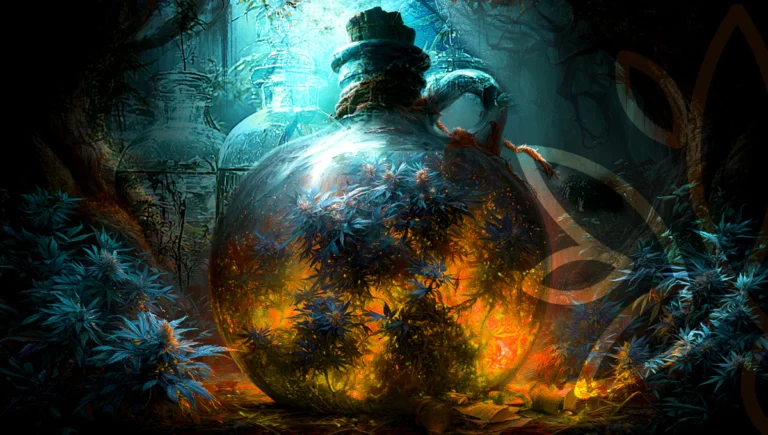
Cannabis did not enter
medicine as a miracle.
It entered as a preparation.
Cannabis entered as a preparation.
That distinction matters.
Modern cannabis discussion often becomes too dramatic. One side wants the plant to be a cure-all. Another side wants it to remain a danger. Between those two positions sits a more useful history: cannabis as a medicine cabinet object, handled through preparation, observation, uncertainty and changing standards of evidence.
In the 19th century, cannabis entered Western medical discussion with renewed force through physicians working in colonial India. W.B. O’Shaughnessy is central to that story. His reports on Indian hemp helped bring cannabis preparations into British and European medical discussion, particularly in relation to tetanus, rheumatism, cholera and convulsive disorders.
This history should not be romanticised.
Nineteenth-century medicine did not operate
by modern standards.
But that does not make the history meaningless.
It makes it human.
Doctors and pharmacists were working with what they had: plant material, alcohol, extracts, patient observation, case reports, experience and caution. Cannabis was not understood as modern cannabinoid science understands it today. It was a preparation with effects, risks, uncertainties and practical uses.
The medicine bottle is important here.
A surviving bottle of tincture of cannabis indica in the Science Museum Group collection reminds us that cannabis was once a physical pharmacy object. Not a slogan. Not a lifestyle product. Not a culture-war symbol. A labelled bottle, made for use, storage and dispensing.
This is exactly the kind of object LIBERA HERBA should notice.
Because objects cool the argument.
A bottle does not prove that cannabis was safe for everything.
It proves that cannabis was there.
Then the cabinet changed.
In the early 20th century, cannabis became increasingly entangled with state drug laws, moral panic, racialised fear, international control and administrative pressure. The Marihuana Tax Act of 1937 did not affect only non-medical use. It also made professional contact with cannabis more difficult, more visible and more legally risky. In 1942, cannabis was removed from the U.S. Pharmacopoeia, marking a key moment in its disappearance from formal American pharmaceutical legitimacy.
This is where medical cannabis history becomes part of the larger LIBERA HERBA story. Law and paperwork did not only police behaviour. They shaped what kinds of knowledge could continue. Once cannabis became administratively dangerous, medical curiosity had to move more carefully, more slowly, or not at all.
The modern return of medical cannabis is therefore not a simple “rediscovery”.
It is a repair job.
A difficult one.
Today’s medical cannabis world has better tools: cannabinoid chemistry, lab testing, controlled products, clinical trials, pharmacology, patient registries, adverse-event monitoring and more precise language. But it also has new noise: wellness claims, marketing, overpromising, under-testing, fashionable extracts and confusion between medical evidence and personal testimony.
LIBERA HERBA should hold both truths.
Cannabis has real medical history.
Cannabis also has real medical hype.
The correct response is not cynicism.
It is discipline.
The question is never simply:
“Is cannabis medicine?”
The better questions are:
This is how the plant returns responsibly.
This is the bridge between the old bottle and the modern lab report.
The 19th-century tincture tells us that cannabis once belonged in the medicine cabinet. Modern science tells us that belonging is not enough. A preparation must be understood, tested, labelled and used with care.
The archive gives memory.
Measurement gives responsibility.
Together, they offer a better cannabis education than either nostalgia or panic.
For LIBERA HERBA, the medicine cabinet is not a shrine. It is a lesson.
Cannabis did not enter medicine as a miracle.
It entered as a preparation.
Cannabis entered modern Western medicine mostly as preparations: tinctures, extracts and pharmaceutical products.
This matters because it keeps the history practical.
A medicine is not a myth.
It is a preparation that must be made, stored, dosed and judged.
The medicine cabinet preserves a history of preparations, interrupted research and changing standards of evidence.
The old bottle proves that cannabis once had a place in formal medicine. Modern science must decide where, how and under what conditions it belongs now.
Factual Note
Cannabis preparations entered renewed Western medical discussion in the 19th century, especially through the work of W.B. O’Shaughnessy in colonial India. Cannabis was used in forms such as tinctures and extracts, and surviving pharmacy objects show it as a material medicine cabinet item.
In the United States, the 1937 Marihuana Tax Act and the 1942 removal of cannabis from the U.S. Pharmacopoeia contributed to its disappearance from formal pharmaceutical legitimacy. Modern medical cannabis should be understood through preparation, cannabinoid content, dose, route, evidence, product quality and risk — not through miracle claims or prohibition-era panic.
A living archive of cannabis—its cultivation in practice and its traces across science, culture, language, power and memory.
Join early.
Keep the archive open.
The VADEMECUM is becoming a living archive of guides, tools, notes and practical plant knowledge.
Free member access. Join early. Keep the archive open.
Join early.
Keep the
archive open.
The VADEMECUM is not just a book anymore. It is becoming a living archive of guides, tools, notes and practical plant knowledge.
Free member access. Join early. Keep the archive open.
The VADEMECUM is becoming a living archive of practical plant knowledge.
Free member access.