

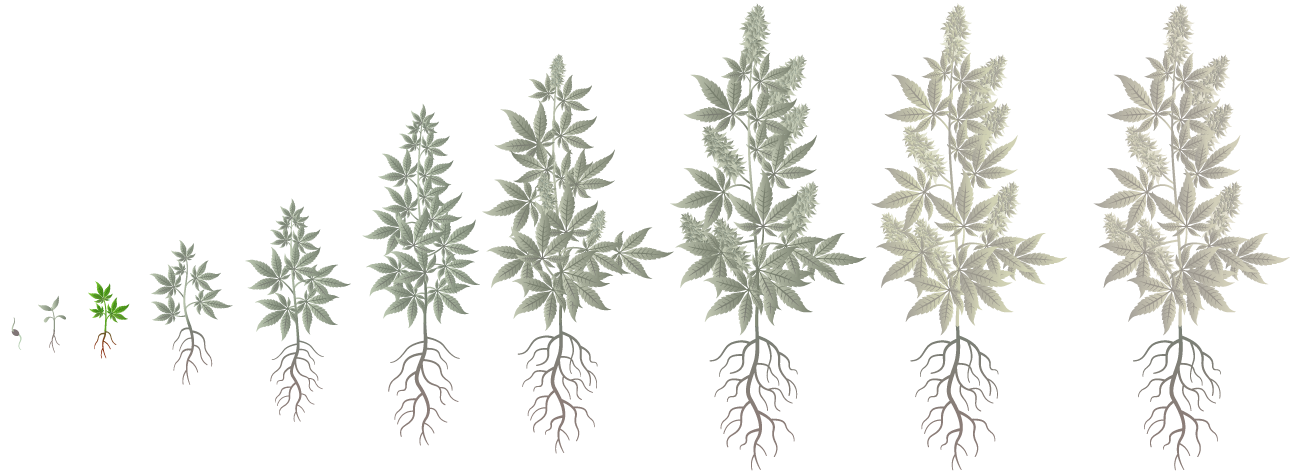
The Seedling Phase is the delicate period where the cannabis plant establishes its first true leaves and begins root development. Proper care, including hydration, light exposure, and early nutrient management, is crucial for healthy progression into vegetative growth.
| Parameter | Ideal range |
| Water pH (Soil) | 6.0–6.5 |
| Water pH (Coco Coir) | 5.7–6.2 |
| Water pH (Hydroponics) | 5.5–6.0 |
| EC Soil (mS/cm) | 0.6–0.8 |
| EC Coco Coir (mS/cm) | 0.8–1.0 |
| EC Hydroponics (mS/cm) | 0.9–1.2 |
| Day Temperature (°C/°F) | 22–26°C / 72–78°F |
| Night Temperature (°C/°F) | 20–24°C / 68–75°F |
| Root Zone Temperature (°C/°F) | 20–24°C / 68–75°F |
| Leaf Surface Temperature (°C/°F) | 22–24°C / 72–75°F |
| Related Humidity (RH%) | 65–75% |
| VPD (kPa) | 0.6–0.8 |
| Optimal CO₂ (ppm) | 600–800 |
| PAR (μmol/m²/s) | 200–400 |
| Lights Hrs/Day | 18–20/6 |
| Light Intensity (%) | 20–40 |
| Light Distance (cm/in) | 60–70/24–28 |
| Substrate Moisture | Slight dry-down between waterings |
| Primary Nutrients | N, P, K (low) |
| Secondary Nutrients | Ca, Mg, S (trace) |
| Micronutrients | Fe, Zn, Mn, B, Cu, Mo |
| N-P-K | 2-1-2 |
| LST | None |
| HST | None |
| Medium | Frequency | Volume (ml/L) | Runoff % |
| Soil | Every 1–3 days | 100–150 ml | 5–10% |
| Coco Coir | Daily | 120–200 ml | 10–15% |
| Hydroponics | Continuous | Maintain aeration | Maintain reservoir |
The Seedling Phase requires minimal nutrients to support the development of roots and true leaves. A balanced NPK ratio (2-1-2) with essential micronutrients like iron and magnesium is recommended at low EC levels. Gradual increases in nutrient strength can begin as the plant shows healthy growth.
| Milestones | ⬜ | Development of 2–3 sets of true leaves. |
| ⬜ | Roots visibly established and beginning lateral growth (if observed in clear containers or hydro setups). | |
| ⬜ | Seedling stem has strengthened and thickened. | |
| Checklist | ⬜ | Light intensity adjusted to avoid stretching. |
| ⬜ | Humidity dome removed to acclimate to ambient air. | |
| ⬜ | First light feeding successfully completed. |
The seedling phase begins once the seed sprouts and its first cotyledon leaves emerge.
The seedling phase typically lasts 2–3 weeks, depending on conditions and the strain.
Seedlings require low-intensity light, around 200–400 μmol/m²/s, for 18 hours a day.
Maintain temperatures between 22–26°C (72–78°F) & humidity at 65–75%.
Water every 2–3 days for soil and daily for coco, ensuring light and even moisture without waterlogging.
Position lights 60–70 cm (24–28 in) above seedlings and ensure light intensity is sufficient.
Cotyledons are the first leaves that appear and provide initial energy for seedling growth.
Yes, gentle airflow strengthens stems and prevents mould.
Yellowing may indicate overwatering, nutrient deficiency, or incorrect pH levels.
Avoid overwatering, maintain good airflow, and use sterile substrate to prevent fungal infections.
Yes, mycorrhizal fungi enhance root development and nutrient absorption when applied early.
No, cotyledons naturally fall off once the seedling establishes true leaves.
Gradually decrease the light distance over several days to acclimate seedlings to higher intensity.
Uneven growth may result from inconsistent light exposure or genetic variability.
Foliar feeding isn’t necessary for seedlings but can be used sparingly for micronutrient supplementation.
Transplant seedlings when roots are visibly established or when they outgrow their starter container.
Provide gentle airflow and consistent light to strengthen seedling stems.
Νοταε
Topics
seedling, cotyledons, first leaves, light, humidity, fragility
Focus Keyword
seedling phase | cannabis growth stage
Description
Fragile but determined. The seedling phase demands light restraint, minimal feeding and patience. What can go wrong here sets the tone for everything that follows.

Join early.
Keep the
archive open.
The VADEMECUM is not just a book anymore. It is becoming a living archive of guides, tools, notes and practical plant knowledge.
Free member access. Join early. Keep the archive open.
The VADEMECUM is becoming a living archive of practical plant knowledge.
Free member access.